9 Articles for 'Daum'
- 2009/02/25 Duel of Korean maps shows how difficult it is to dethrone the ruling king
- 2008/07/29 Daum to share revenue with news content providers
- 2008/06/27 On the internet, it's not 20/80 - it's more like 10/70
- 2008/06/04 Lunch 2.0 at Daum
- 2008/05/20 Daum search traffic surged, helped by cafe search
- 2008/05/10 Is the Chinese BBS really the future of social media? (3)
- 2008/03/24 Founder of Korea's #2 portal steps down
- 2008/01/25 Youtube Opens Korean Service - But Will It Succeed? (7)
- 2007/11/20 2008 Mashup Korea and Korea's Open API status
Duel of Korean maps shows how difficult it is to dethrone the ruling king
Web 2.0 | 2009/02/25 09:51 | Web 2.0 Asia
Blogger Channy Yun, on his Korean blog, recently posted that Daum Map's traffic has slided back to its original level after a shark-jump peak in late January, when Daum launched Street View service.

Source: Channy's blog
All in all, Daum has a great map service, better than Naver's in ways (take the Street View, currently not provided by Naver, for one). However, Naver seems to be such a strongly entrenched top-of-the-mind choice for most Koreans, and the "escape velocity" for any second player to take off and surpass Naver can be just too high. Got a great feature? People may give it a try or two, but chances are they will just go back to Naver. The Economist has a recent article on Naver's success, which I'll cover on the next post.
Meanwhile, on a separate note, Korean map service players may be suffering from too many government regulations. No Cut News reported (article in Korean) that Daum had to remove the Blue House, Korea's Oval Office, from its map service due to government request. (Left in the picture is what shows on Google Maps, while on the right you can see the whole area has been greened out). Google itself had enormous difficulty launching the map service in Korea due to many regulations. That's probably what you get when your country, while having bleeding-edge technologies, is still bordering with a military enemy who is very open about its missile launching programs.

Daum CEO (source: Yeonhap News)
In Korea, leading newspaper companies have provided full content to the so-called portals, such as Naver or Daum, which are the de facto destination site for many Korean netizens. As a result, Korean online users didn't have to browse through different newspaper sites - they could just visit their portal of choice and consume all the news from different media in a "one-stop shopping" manner.
The problem was, as the news from various media got represented in a uniform way following the portals' look and feel, users perceived the news was actually coming from the portals and paid less attention to where that news came from. This led to less traffic to the original newspaper sites.
By contrast, Yahoo News mostly aggregate news from AP, AFP, Reuter - the so-called "news agencies" whose business model itself is news content syndication; Google News displays only the links to the original sites, and by clicking those links, users go to the original news sources.
As such, there have been great tensions between the original news content providers and the portals - And it looks like Daum is taking one step back now.
Under the new announcement, Daum will share ad revenue from its news pages with the original news content providers; And perhaps more importantly, will also provide an "outlink" option, where only the links to the original news (and maybe partial content) get displayed on Daum's news page, as opposed to the full content.
So how is news content consumed online in other Asian countries? Do users mostly visit (or subscribe to) each and every news site, or do users mostly check out aggregation sites, such as the portals? If the latter, how do original content providers and the channel owners (eg. portals) resolve the possible conflicts?
TAG Daum, News
As mentioned on a previous post, Agora, Korean portal site Daum's web forum service, has been on fire during the recent (ongoing, actually) anti-beef-import candlelight protests.
It turned out that (link in Korean) the top 3.3% of the users contributed for nearly half of the whole posts; top 10% accounted for 71% of the entire postings.
This is a (rather dramatic) case that shows there are so few content creators (as opposed to content consumers) on the web. So forget about 20/80 rule - it's more like 10/70, or even 3/50.
Oh, by the way, this is crazy: The top 10 users logged whopping 21,180 posts during the last two months or so, averaging nearly 30 posts per day/person. Remember we're talking about long articles, sometimes really really long. And most articles are well-written, as the authors are well aware of how much of hateful comments they will get if they do a crappy post.
Of course these folks are not paid for their work or anything like that. Hey, Techcrunch writers - did you guys just whine "too many posts, too little time"? ;)
It turned out that (link in Korean) the top 3.3% of the users contributed for nearly half of the whole posts; top 10% accounted for 71% of the entire postings.
This is a (rather dramatic) case that shows there are so few content creators (as opposed to content consumers) on the web. So forget about 20/80 rule - it's more like 10/70, or even 3/50.
Oh, by the way, this is crazy: The top 10 users logged whopping 21,180 posts during the last two months or so, averaging nearly 30 posts per day/person. Remember we're talking about long articles, sometimes really really long. And most articles are well-written, as the authors are well aware of how much of hateful comments they will get if they do a crappy post.
Of course these folks are not paid for their work or anything like that. Hey, Techcrunch writers - did you guys just whine "too many posts, too little time"? ;)
The latest Lunch 2.0 Seoul, the occasional get-together among web industry people in Korea, was held at Daum Communication, a prominent internet portal of Korea.
Daum's CEO himself, Mr. Seok, came this time and spoke about Daum's strategies and challenges. He later found himself on a hot seat, taking some tough questions like "Is Daum interested in acquiring startup innovations at all?"

Here I'm pitching the Open Web Asia '08 (we finally have the name for our conference.) Lunch 2.0 members had great interest and some even showed interest in sponsoring the conference. Speaking of the conference, although I've been quiet about it all this time, we have been making some very nice progress so far. I'll update on that next week.
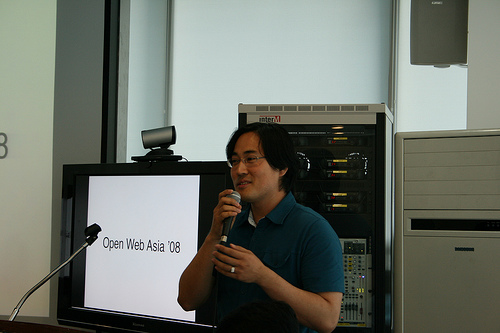
Daum's CEO himself, Mr. Seok, came this time and spoke about Daum's strategies and challenges. He later found himself on a hot seat, taking some tough questions like "Is Daum interested in acquiring startup innovations at all?"
Here I'm pitching the Open Web Asia '08 (we finally have the name for our conference.) Lunch 2.0 members had great interest and some even showed interest in sponsoring the conference. Speaking of the conference, although I've been quiet about it all this time, we have been making some very nice progress so far. I'll update on that next week.
TAG Daum, Lunch 2.0
Daum, Korea's #2 portal, had 27M monthly search queries in April (link in Korean), a 75% increase over two months.
For portals, search is the name of the game, and Daum's position in Korea is no better than Yahoo's in the US. Naver, the top dog, has over 70% market share. Daum didn't hide its intention to play a catch-up game in search market, and their weapon of choice was to introduce better search over its "cafe" (web bulletin board) content.
Daum believed web BBSes are some great archives of useful knowledge, and the strategy seems to pay off, judging from Daum's search market share gains. A few posts before, I called BBS a rather older system - now, BBS combined with very robust search might be an entirely different story.
For portals, search is the name of the game, and Daum's position in Korea is no better than Yahoo's in the US. Naver, the top dog, has over 70% market share. Daum didn't hide its intention to play a catch-up game in search market, and their weapon of choice was to introduce better search over its "cafe" (web bulletin board) content.
Daum believed web BBSes are some great archives of useful knowledge, and the strategy seems to pay off, judging from Daum's search market share gains. A few posts before, I called BBS a rather older system - now, BBS combined with very robust search might be an entirely different story.
The other day, I read a piece on the China Vortex, shared on Google reader by Tangos. (Thanks Tangos - I'm getting lots of insights into the Chinese web industry through your shared blog articles. Of course I enjoy your own too.)
In short, the article said:
Does the fact that BBS is so popular in China today mean a) BBS is the right platform for social media and b) BBS will remain as popular in China for the coming years? I'm not very sure about that, at least using the Korean market as a "canary in coal mine" example.
a) Is BBS the right platform for social media?
If we define "social media" as the collection of unque, diversified individual voices, I don't think BBS is the optimal platform for social media activities - on the contrary, BBSes can often lead to group thoughts and monoculture, where the agenda is largely driven by big voices.
b) Will BBS remain popular in China for the coming years?
In Korea, we have a popular BBS/forum service in "Daum Cafe". Three or four years ago, Daum cafe was arguably THE most popular service for Korean netizens. Today, Daum Cafes are still doing pretty okay I guess, but are definitely not the most popular daily web destination as they once used to be. Over the last several years, Daum Cafe has given much way first to minihompies, and later to blogs.
The problem of Daum Cafe as a BBS-type service was that it wasn't as much focusing on individuals. On BBSes and forums, usually it's difficult to keep track of the messages users left on different spaces and the subsequent comments left by other users. It's also difficult to put one's personal identity to the page that collects all his postings ("My page"), just like a contributor's personal page on Wikipedia is rarely visited (many people don't even know such pages exist). People like group activities too, but basically people are individualistic. Users want to have "their own site" where they have all their content under a specific URL which they can use as personal brands.
+++
I know this is a very crude analogy, but I think the evolution from homepage to BBS to blogs and other forms of social media can be said:
Generation 1 = Homepages = individual "homes" without much communication channels. People sometimes visit other "homes" but communication between homes are generally not very active. Besides, it's generally difficult to build and manage one's own home.
Generation 2 = BBS = town hall meetings or cocktail parties where people gather together and talk about various topics, but not much of "individual space".
Generation 3 = blogs = individual homes with built-in communication system and numerous, instant townhall meetings (i.e. the content aggregation via XML/RSS).
If we look back on the Korean web service market, the game-changing services have walked through the above generations. First the homepages were all the rage (circa 1998), then there were Daum Cafe and other BBS/forum services like Freechal (circa 2000). Then, of course, Cyworld minihompies came along and took the market by storm (2002 or so). And now the name of the game is, arguably, blogs - I'm not saying this because I'm a blog company CEO :)
Of course this is only what happend in the Korean market, and just because something happened in the Korean market doesn't mean it will happen everywhere else. But having said that, I am eager to see if the Chinese' love of BBS will continue or even get stronger, or the Chinese netizens will further embrace blogs or other forms of more "personal" media platform. What do you think?
In short, the article said:
- Much of Chinese internet = BBS
- Often the Chinese "group thoughts/activities", such as the recent (rather unfortunate) "Angry Chinese" incidents, get organized on these BBSes
- Chinese' love of BBS might have come from distrust of traditional media
- Outsiders have not figured this out
So, BBSes are the real social media marketing tool, and as usual, the Chinese are ahead of everyone else, but just haven’t figured out that part themselves. While the west talks about social media and Web 2.0, China has had a version of it for the past ten years. It may not be pretty, but it works.
Does the fact that BBS is so popular in China today mean a) BBS is the right platform for social media and b) BBS will remain as popular in China for the coming years? I'm not very sure about that, at least using the Korean market as a "canary in coal mine" example.
a) Is BBS the right platform for social media?
If we define "social media" as the collection of unque, diversified individual voices, I don't think BBS is the optimal platform for social media activities - on the contrary, BBSes can often lead to group thoughts and monoculture, where the agenda is largely driven by big voices.
b) Will BBS remain popular in China for the coming years?
In Korea, we have a popular BBS/forum service in "Daum Cafe". Three or four years ago, Daum cafe was arguably THE most popular service for Korean netizens. Today, Daum Cafes are still doing pretty okay I guess, but are definitely not the most popular daily web destination as they once used to be. Over the last several years, Daum Cafe has given much way first to minihompies, and later to blogs.
The problem of Daum Cafe as a BBS-type service was that it wasn't as much focusing on individuals. On BBSes and forums, usually it's difficult to keep track of the messages users left on different spaces and the subsequent comments left by other users. It's also difficult to put one's personal identity to the page that collects all his postings ("My page"), just like a contributor's personal page on Wikipedia is rarely visited (many people don't even know such pages exist). People like group activities too, but basically people are individualistic. Users want to have "their own site" where they have all their content under a specific URL which they can use as personal brands.
+++
I know this is a very crude analogy, but I think the evolution from homepage to BBS to blogs and other forms of social media can be said:
Generation 1 = Homepages = individual "homes" without much communication channels. People sometimes visit other "homes" but communication between homes are generally not very active. Besides, it's generally difficult to build and manage one's own home.
Generation 2 = BBS = town hall meetings or cocktail parties where people gather together and talk about various topics, but not much of "individual space".
Generation 3 = blogs = individual homes with built-in communication system and numerous, instant townhall meetings (i.e. the content aggregation via XML/RSS).
If we look back on the Korean web service market, the game-changing services have walked through the above generations. First the homepages were all the rage (circa 1998), then there were Daum Cafe and other BBS/forum services like Freechal (circa 2000). Then, of course, Cyworld minihompies came along and took the market by storm (2002 or so). And now the name of the game is, arguably, blogs - I'm not saying this because I'm a blog company CEO :)
Of course this is only what happend in the Korean market, and just because something happened in the Korean market doesn't mean it will happen everywhere else. But having said that, I am eager to see if the Chinese' love of BBS will continue or even get stronger, or the Chinese netizens will further embrace blogs or other forms of more "personal" media platform. What do you think?
Lee, who still owns about 20% of Daum, was the president and CEO of Daum until about a year ago - but he had resigned from CEO position last September, and now he's no longer the president either.
What's interesting is the speculation that Lee's move might somehow be related to the acquisition rumors surrounding Daum. In the Korean stock market, Daum was the subject of various M&A rumors throughout the past two years.
The fact that Lee is no longer part of Daum's management team suggests the Daum M&A rumors might finally be coming true. So who's buying Daum, if someone does buy the company? We don't know yet - but whoever it might be, the acquirer must be a player that's very determined to compete against Naver, the "king of the hill".
TAG Daum, Jaewoong Lee
launched a few days ago. Although some "in the know" Koreans have been using Youtube, it's the first time Youtube is offered as a fully localized service in Korea.
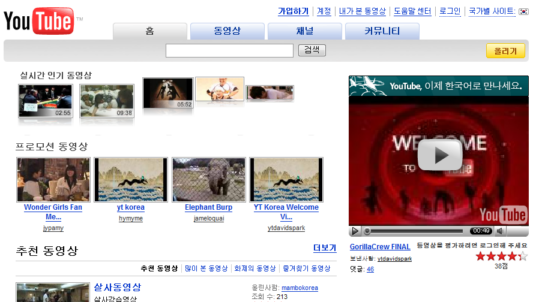
But it's not very clear to me what winning strategies Youtube has for the Korean market. Unlike in Japan, where there haven't been many local incumbents providing online video service, Korea has some pretty strong local players in the sector. (Update: This part was a bit misleading and see my comment below for further clarification). One of the hottest buzzwords among the Korean web industry over the past couple of years has been "UCC", a term Koreans like to use for user-created online videos. With the UCC phenom sweeping the country, Korea has no shortage of capable online video service providers.
As such, Youtube will face some tough competition in Korea, against the likes of Daum TV Pot and Pandora TV. Google Korea says Youtube Korea has partnered with top-tier content partners in Korea and so its forte lies in the content. But then, which online video company doesn't say so?
So here's the brain teaser for you: If you were the person in charge of launching Youtube in Korean market (or you can also put your own country in there), what would you do?
But it's not very clear to me what winning strategies Youtube has for the Korean market. Unlike in Japan, where there haven't been many local incumbents providing online video service, Korea has some pretty strong local players in the sector. (Update: This part was a bit misleading and see my comment below for further clarification). One of the hottest buzzwords among the Korean web industry over the past couple of years has been "UCC", a term Koreans like to use for user-created online videos. With the UCC phenom sweeping the country, Korea has no shortage of capable online video service providers.
As such, Youtube will face some tough competition in Korea, against the likes of Daum TV Pot and Pandora TV. Google Korea says Youtube Korea has partnered with top-tier content partners in Korea and so its forte lies in the content. But then, which online video company doesn't say so?
So here's the brain teaser for you: If you were the person in charge of launching Youtube in Korean market (or you can also put your own country in there), what would you do?
(Via Channy Yun) Daum and NHN will co-host the 2008 Mashup Korea. Mashup Korea will feature Mashup dev challenge (contestants can submit by Feb 10 '08), Mashup Expo (11/29), and Mashup Conference (11/30).
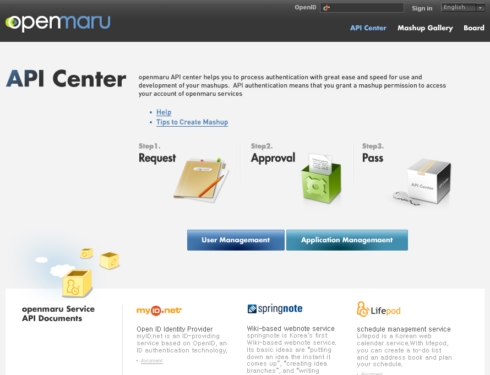
I just followed the links provided on Channy's post to see how Korean web companies are providing open APIs. I think Daum is the best in terms of depth and breadth of open APIs provided. Openmaru is offering an English website for open API developers - check out the site here (the site looks clean and beautiful - now the wholemark of Openmaru).
But most impressive was the link I also found on Channy's post, regarding the open API-based strategic partnership between Auction and Daum cafe.
Daum cafe is Korea's biggest web BBS, and Auction is Ebay's Korean service.
Thanks to the APIs provided by the two services, user can cross-post an item on Daum cafe and on Auction at the same time, or sell items on Daum cafe using Auction's backend transaction service (such as escrow service).
What does this mean? Let's say you posted an entry about your used Ford on your web BBS. Imagine the entry will be automatically cross-posted under Ebay Auto, and visitors to the web BBS can buy your Ford using the same backend transaction system of Ebay.
Daum cafe is a huge service and Auction is now expecting its C2C e-commerce will see an increased volume of 25% next year, thanks largely to Daum cafe partnership. This is one of the best practices of open API based partnership, Channy says.
I just followed the links provided on Channy's post to see how Korean web companies are providing open APIs. I think Daum is the best in terms of depth and breadth of open APIs provided. Openmaru is offering an English website for open API developers - check out the site here (the site looks clean and beautiful - now the wholemark of Openmaru).
Openmaru open API page
But most impressive was the link I also found on Channy's post, regarding the open API-based strategic partnership between Auction and Daum cafe.
Daum cafe is Korea's biggest web BBS, and Auction is Ebay's Korean service.
Thanks to the APIs provided by the two services, user can cross-post an item on Daum cafe and on Auction at the same time, or sell items on Daum cafe using Auction's backend transaction service (such as escrow service).
What does this mean? Let's say you posted an entry about your used Ford on your web BBS. Imagine the entry will be automatically cross-posted under Ebay Auto, and visitors to the web BBS can buy your Ford using the same backend transaction system of Ebay.
Daum cafe is a huge service and Auction is now expecting its C2C e-commerce will see an increased volume of 25% next year, thanks largely to Daum cafe partnership. This is one of the best practices of open API based partnership, Channy says.