12 Articles for 'Japan'
- 2009/06/17 Naver Japan search finally unveiled (3)
- 2009/02/27 "Naver California"? (2)
- 2008/05/15 Cyworld Japan looks desparate (3)
- 2008/04/15 Japan's NTT DoCoMo sees its market share drop below 50%
- 2008/04/08 Japan's Livedoor frontpage renewal puts more focus on blog
- 2008/02/29 Not Made in Japan (3)
- 2008/02/25 CNet Japan announces 10 promising Japanese tech ventures
- 2008/01/10 Baidu getting ready to launch in Japan (6)
- 2007/12/06 Japanese people are creative - it's just that loyalty is being valued more (6)
- 2007/09/02 Purohu is popular among Japanese teens (3)
Naver Japan search, the culmination of years of hard work by the Korean search giant, has finally been unveiled and is now available to some 5,000 beta testers. Reviews are already coming in, and based on the initial impressions and feedbacks, it looks like the service is quite well received among the closed beta testers.
What's noticeable even at the first sight is the clean UI. The Naver hallmark green hues are used quite extensively but in an eye-pleasing way. On the front page, hot search queries are placed prominently (using flash graphics), showing current memes and attracting impluse clicks.
Image from Hatena Blog
Naver uses flash graphics to create a graphically rich UI, much in contrast to the bare-bones UI of Google and Baidu. For example, images on the universal search results page are displayed with a coverflow interface (see below). And the use of flash graphics doesn't seem to particularly slow down the sites. Besides, what might also help is that Japan is already one of the top countries in the world in terms of broadband use.
Image from Hatena Blog
Naver is arguably the pioneer of universal search, where different types of search results are displayed together on one big screen so that user can find all related stuff in one place. Naver Japan gives universal search results as the default view, but in addition to universal search, Naver also offers other interesting search types (navigatable by choosing different tabs.)
In addition to image and video search, "Kuchikomi (クチコミ)" search allows searching for "what people say about this topic" and displays BBS or Q&A content. "Theme (テーマ)" search shows related topics or categories associated with a certain search keyword so that user can do search focusing on a specific category. For example, for a search term "BMW", Naver Theme search gives "Car", "Film", "Person/group", "Game", "Sports", etc. Choose "Car" and you naturally get BMW cars as search results; Choose "Person/group" and you get people related to BMW, such as team BMW race drivers.
Also "Matome (まとめ)" tries to employ user participation for search results. User can create a topic page and populate that page with content, which will be given out as search results when other people search for that topic on Matome search. User can create a links collection page, image/video collection page, quotes collection page, or custom content page for a given keyword. For instance, you can create a tell-it-all page for Macbook Pro. It's sort of a combination of Wikipedia and search, it seems.
It remains to be seen if Naver will see a similar level of success in Japan as it had in Korea, but at least this much is clear: Naver seems to have achieved a difficult feat of creating a service that's well localized for the target market, while not losing its home-brewed forte and identity. For Naver, success in the Japanese market is ever important. Japan service will be the "canary in a coalmine" for Naver, as it will tell Naver if their success formula is just a Korean thing or something that can work anywhere else in the world.

A recent article by the Economist notices yet again Naver's success in the Korean market. Naver's total domination in Korea hardly surprises anyone, but what was quite interesting was Naver's ambition to launch in other countries including the US.
... Mr. Chae [Naver CEO] says he plans to launch several more culturally specific search engines, such as “Naver California”, “Naver Korean-American” or “Naver Chinese-American”. That would be attacking Google on its home turf. Is this too ambitious? Naver say never.
Attacking Google on its home turf? Wow, when was the last time someone even dared to think about it?
So is Google now supposed to be shaken to its knees? Perhaps not yet. But don't label this as an absurdly far-fetched idea just yet. Remember Naver's tactic wouldn't be a head-on collision with Google.
Though both are called search, Naver and Google are quite different species. Naver's forte is in aggregating useful information for popular topics, often created by the users themselves (blogs and Q&A searches), and presenting such information in a very human-friendly way (heard "universal search"?). Unlike Google, Naver doesn't rely almost entirely on the brute force performance of its search algorithm.
Some users may prefer Naver's approach to search - which is what Naver hopes would be the case for the Japanese, the first foreign market the company is targeting at and putting lots of efforts in. If Naver can make a visible dent in the Japanese search market, it will then go to China, and then... who knows where else. Which is what makes Naver's Japan search, reported to be imminent to launch, all the more important.
Cyworld Japan announced a site renewal plan where it will essentially turn into a place for pro-Korean community in Japan.
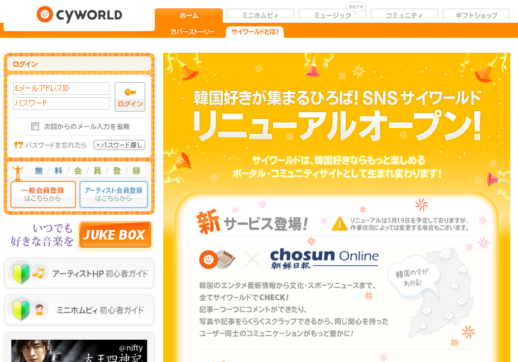
This might make sense as what little number of Cyworld users in Japan are mostly K-wave followers or Korean expats anyway.
But on the other hand, this is something like, let's say, Xing France announcing it will focus on offering German job information to French people. Bad analogy, I know, but my point is Cyworld JP is essentially turning itself into a service that's quite limited to serving small, niche demographics. Which is their own statement that Cyworld JP is irrelevent to the mainstream Japanese web users.
Just another evidence that in Asian web industry, it seems so difficult (nearly impossible) to produce a "cross-cultural" hit service, whose success isn't limited only to its own country. Which is a topic that's well worth discussing in our upcoming Asia Web conference.
This might make sense as what little number of Cyworld users in Japan are mostly K-wave followers or Korean expats anyway.
But on the other hand, this is something like, let's say, Xing France announcing it will focus on offering German job information to French people. Bad analogy, I know, but my point is Cyworld JP is essentially turning itself into a service that's quite limited to serving small, niche demographics. Which is their own statement that Cyworld JP is irrelevent to the mainstream Japanese web users.
Just another evidence that in Asian web industry, it seems so difficult (nearly impossible) to produce a "cross-cultural" hit service, whose success isn't limited only to its own country. Which is a topic that's well worth discussing in our upcoming Asia Web conference.
New York Times reported that Japan's NTT DoCoMo saw its market share in its domestic Japanese market fall below 50%, the first time in almost 10 years.
The winner in this fully saturated Japanese mobile service market (read: a zero-sum game) seems to be Softbank Mobile. (My previous piece about DoCoMo vs. Softbank Mobile is here).
Meanwhile, NTT DoCoMo will test mobile fragrance service: Like ringtones, "scents" can be downloaded and played back (ie. generated) by a phone-embedded aroma generator. Well, mobile fragrance service is surely cool and futuristic and all that, but I guess they should first do something about their "stinking" market performance.
The winner in this fully saturated Japanese mobile service market (read: a zero-sum game) seems to be Softbank Mobile. (My previous piece about DoCoMo vs. Softbank Mobile is here).
Meanwhile, NTT DoCoMo will test mobile fragrance service: Like ringtones, "scents" can be downloaded and played back (ie. generated) by a phone-embedded aroma generator. Well, mobile fragrance service is surely cool and futuristic and all that, but I guess they should first do something about their "stinking" market performance.
Japan's Livedoor frontpage renewal puts more focus on blog
Web 2.0 | 2008/04/08 23:52 | Web 2.0 Asia
Japan's Livedoor, which once was a posterchild web company of Japan (before the infamous financial scandal, of course), launched a renewed main page. The central theme of the renewal seems to be blogging.
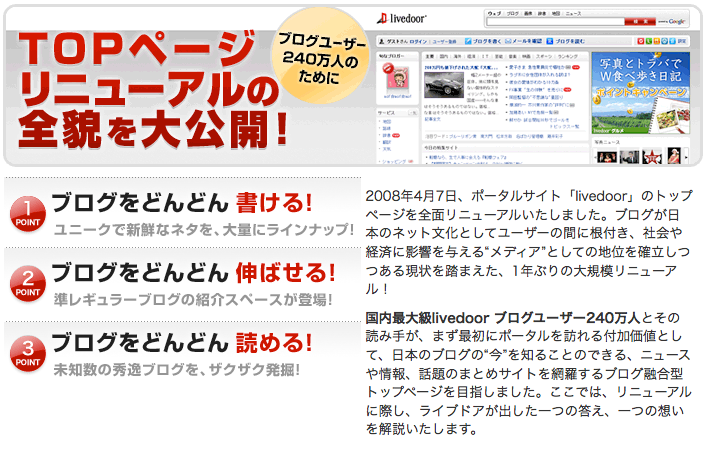
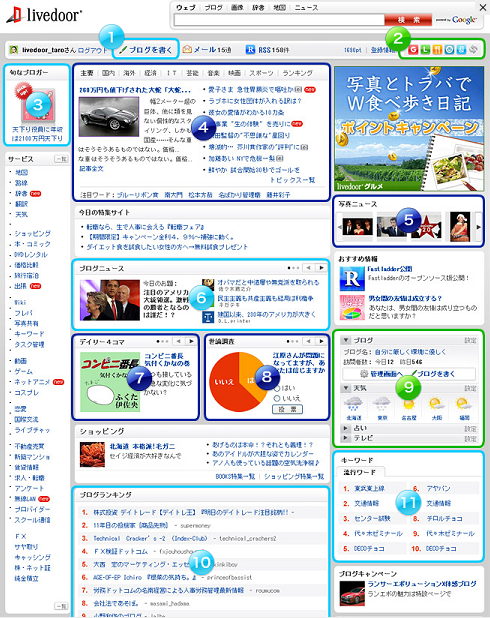
Livedoor lists 11 major changes on the new website: Five out of those eleven are blog-related, such as a direct link to blogging, blog news, blog keywords, and blog ranking.
With close to 2.5 million users, Livedoor is a leading blog service provider of Japan, the company claims. Focusing on blogging seems a right, almost inevitable choice for Livedoor: Japan's internet portal market is being dominated by Yahoo! Japan, a service that's so successful as to have even .
Meanwhile, it's interesting to note that major portals in Asia are putting more and more focus on blogging. Korea's Naver is all about blog (so is the company's ex-CEO), Cyworld is launching a new blog service, and now Livedoor is essentially turning into a blog portal. This makes sense as user-generated content becomes the king, the tools to help users easily create content on the web becomes more important - and the first among those tools is, obviously, blog. In that regard, our company seems to be in the right business (Ehem, sorry about the navel-gazing.)
Livedoor lists 11 major changes on the new website: Five out of those eleven are blog-related, such as a direct link to blogging, blog news, blog keywords, and blog ranking.
With close to 2.5 million users, Livedoor is a leading blog service provider of Japan, the company claims. Focusing on blogging seems a right, almost inevitable choice for Livedoor: Japan's internet portal market is being dominated by Yahoo! Japan, a service that's so successful as to have even .
Meanwhile, it's interesting to note that major portals in Asia are putting more and more focus on blogging. Korea's Naver is all about blog (so is the company's ex-CEO), Cyworld is launching a new blog service, and now Livedoor is essentially turning into a blog portal. This makes sense as user-generated content becomes the king, the tools to help users easily create content on the web becomes more important - and the first among those tools is, obviously, blog. In that regard, our company seems to be in the right business (Ehem, sorry about the navel-gazing.)
TAG Japan, livedoor,
Newsweek Feb 25 issue has a featured article titled "Not Made in Japan":

"With the right approach [NTT Docomo] could have become a Google," says Gerhard Fasol of the Tokyo consultancy Eurotechnology Japan. "They had the chance—but they blew it."I think largely the same thing can be said of big Korean companies too. Though it contains some dose of cliche (such as Japanese firms don't welcome stick-out genius as much as US companies do), the article's worth a read - go check it out.
Photo from Newsweek.com
TAG Japan, Newsweek
CNet Japan announced 10 promising Japanese tech ventures in their recent "Tech Venture 2008". Looking at these 10 companies will hopefully provide some insights into the newest tech trends of Japan.
Here's the link to the original CNet announcement (in Japanese), and here's an English blog about the five of ten award-winners, written by Akihito Fujii. The other five is to be introduced in part 2 of Fujii's blog, which isn't up just yet.
Personally, I like Filimo, a user-created video commercials service. (An English link is here). Also I find it interesting (not surprising however) that six of the ten award-winning companies seem to be mobile-oriented services. Check out Fujii's blog for more information about individual companies.
China's Baidu is poised to launch officially in Japan on Jan 23.
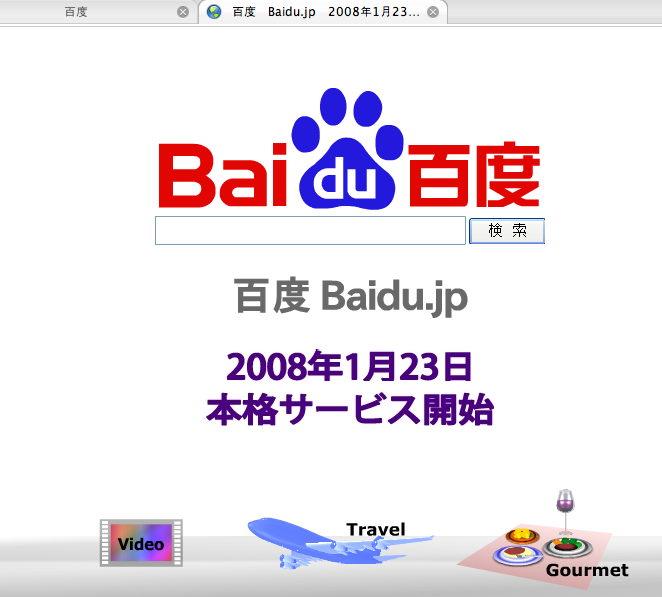
Will 2008 see Asian search giants - Baidu, Naver, Yahoo Japan - battle it out, with the first battlefield being the Japanese market? (Here's a previous short take on Naver's new Japan office.)
But what exactly is Baidu's strategy and competitive edge over incumbents in Japan, most notably Yahoo Japan? What's their unfair advantage? Can anyone shed some light on this?
Will 2008 see Asian search giants - Baidu, Naver, Yahoo Japan - battle it out, with the first battlefield being the Japanese market? (Here's a previous short take on Naver's new Japan office.)
But what exactly is Baidu's strategy and competitive edge over incumbents in Japan, most notably Yahoo Japan? What's their unfair advantage? Can anyone shed some light on this?
Japanese people are creative - it's just that loyalty is being valued more
Other | 2007/12/06 20:07 | Web 2.0 Asia
(Disclaimer: This post doesn't have anything to do with technology or web 2.0)
Gen Kanai wrote an interesting piece titled "Why Apple is not Japanese".
Well, first of all, I don't think Japanese people are not creative - had they not been creative, probably some things that we take for granted today, instant Ramen for starters, wouldn't have existed at all.
But having said that, while I was in Japan, I made an (totally and entirely subjective) observation on a trait of the Japanese people, which in my thought helps making the Japanese look less creative than they really are.
I've been in Japan for only seven months, so there is no way I can ever claim myself as a "Japan expert". But this thing about the Japanese people that kind of jumped to my eyes was their tendancy to "keep doing" whatever they are up to, or whatever they thought they were destined to be up to.
And this tendency, in my opinions, comes from the fact that the Japanese society puts so much value on loyalty, commitment, "being there and doing his thing all the time", and so forth.
What does this mean? Well for example, let's see the "Hachiko dog" whose bronze statue is in front of the Shibuya station. The dog's good deed, as far as I know, was to wait for its missing owner on the same spot for many years.

On the other hand, a revered dog in Korea, named "Oh-su dog", saved its owner from a fire by wetting itself, jumping into the fire, and then rolling its body across the owner so he won't burn. The dog then finally perished, and the people in town later put up a statue to remember the dog.

Obviously I can't conclude everything only with these two dogs' stories, but what I take from these stories about two dogs is the difference in terms of where people put most value in Japan and in Korea - between a) being loyal and sticking to one's purpose/duty/destiny/job (in Japan), and b) putting the desired outcome first and coming up with various solutions, doing no matter what it takes (in Korea).
To put it rather simply (despite the danger of oversimplifying things), I think for Koreans "getting there" matters, while for the Japanese "continuing the things to get there" matters.
Another case in point (or what I think is the case in point) : The old Japanese movie "Potpoya (鐵道員)".
In this movie, there's this officer at a small, remote, almost deserted train station who keeps committing himself to the job although there's nearly no one who uses that station. As I saw the movie, I almost shouted to myself "What are you doing there? Quit the damn job and get the hell out of there..."

I know it goes deeper than that and appreciate there's lots of meaning in there (Don't get me wrong, Potpoya is one of my favorite movies.) But I still can't help thinking it would be harder for me, a non-Japanese, to even understand (let alone getting moved by) the officer sticking to his job-cum-destiny no matter what.
Just like the case of Hachiko dog, the train station officer is also revered for "being there" all the time, no matter what. I think the Japanese people's work ethic, the obsessive pursuit of "Shikoto" or the "work" that almost looks to be ingrained in the Japanese DNA, could be looked at from this angle.
Going back to Gen's original post, well, creativity is not exactly in line with "keep doing it" or "being there no matter what" mentality. Creativity is about breaking the rules, being iconoclastic, stepping out of the box, etc.
You might call the Hachiko dog or the train station officer in Potpoya loyal, committed, and consistent. But it would be difficult to call them, well, creative.
So again, I believe the Japanese people indeed are creative, but as the society values consistent commitment so much that the creativity is not valued as much as it is in the US or even Korea.
Well, that was my totally subjective and personal observation - but then who am I to say? I was in Japan for only 7 short months :)
Gen Kanai wrote an interesting piece titled "Why Apple is not Japanese".
Well, first of all, I don't think Japanese people are not creative - had they not been creative, probably some things that we take for granted today, instant Ramen for starters, wouldn't have existed at all.
But having said that, while I was in Japan, I made an (totally and entirely subjective) observation on a trait of the Japanese people, which in my thought helps making the Japanese look less creative than they really are.
I've been in Japan for only seven months, so there is no way I can ever claim myself as a "Japan expert". But this thing about the Japanese people that kind of jumped to my eyes was their tendancy to "keep doing" whatever they are up to, or whatever they thought they were destined to be up to.
And this tendency, in my opinions, comes from the fact that the Japanese society puts so much value on loyalty, commitment, "being there and doing his thing all the time", and so forth.
What does this mean? Well for example, let's see the "Hachiko dog" whose bronze statue is in front of the Shibuya station. The dog's good deed, as far as I know, was to wait for its missing owner on the same spot for many years.
The Hachiko dog
On the other hand, a revered dog in Korea, named "Oh-su dog", saved its owner from a fire by wetting itself, jumping into the fire, and then rolling its body across the owner so he won't burn. The dog then finally perished, and the people in town later put up a statue to remember the dog.
The Oh-su dog
Obviously I can't conclude everything only with these two dogs' stories, but what I take from these stories about two dogs is the difference in terms of where people put most value in Japan and in Korea - between a) being loyal and sticking to one's purpose/duty/destiny/job (in Japan), and b) putting the desired outcome first and coming up with various solutions, doing no matter what it takes (in Korea).
To put it rather simply (despite the danger of oversimplifying things), I think for Koreans "getting there" matters, while for the Japanese "continuing the things to get there" matters.
Another case in point (or what I think is the case in point) : The old Japanese movie "Potpoya (鐵道員)".
In this movie, there's this officer at a small, remote, almost deserted train station who keeps committing himself to the job although there's nearly no one who uses that station. As I saw the movie, I almost shouted to myself "What are you doing there? Quit the damn job and get the hell out of there..."
I know it goes deeper than that and appreciate there's lots of meaning in there (Don't get me wrong, Potpoya is one of my favorite movies.) But I still can't help thinking it would be harder for me, a non-Japanese, to even understand (let alone getting moved by) the officer sticking to his job-cum-destiny no matter what.
Just like the case of Hachiko dog, the train station officer is also revered for "being there" all the time, no matter what. I think the Japanese people's work ethic, the obsessive pursuit of "Shikoto" or the "work" that almost looks to be ingrained in the Japanese DNA, could be looked at from this angle.
Going back to Gen's original post, well, creativity is not exactly in line with "keep doing it" or "being there no matter what" mentality. Creativity is about breaking the rules, being iconoclastic, stepping out of the box, etc.
You might call the Hachiko dog or the train station officer in Potpoya loyal, committed, and consistent. But it would be difficult to call them, well, creative.
So again, I believe the Japanese people indeed are creative, but as the society values consistent commitment so much that the creativity is not valued as much as it is in the US or even Korea.
Well, that was my totally subjective and personal observation - but then who am I to say? I was in Japan for only 7 short months :)
A service called "Strategic Purohu", provided by cgiboy.com, a Rakuten company, is quite popular among the Japanese teens. The Strategic Purohu service is all about completing personal profiles. By simply answering the questions given by the service, user completes his/her profile. There are nearly a hundred questions including "What's your dream car?" or "Your favorite song at Karaoke" as well as pretty basic questions. While not all of these questions are mandatory, the more questions a user answers, the more complete the user's profile becomes. So it's like Linked In for teens on mobile, but the content is personal not professional.
Once they have their profile (purohu) pages set up, teens share the page addresses with each other. So there's a certain feeling that this mobile-only service is pretty secure and not entirely open to general public. As such, Japanese teens upload their real picture on their purohu pages - such a rare practice in Japan.
Purohu is a pretty simple yet interesting enough service. It reminds me again that a good mobile service doesn't have to be rocket science.