16 Articles for 'cyworld'
- 2009/11/09 Cyworld US Doesn't Know "Graceful Sunset" (6)
- 2009/07/08 Cyworld to launch App store (3)
- 2009/05/14 Cyworld to embrace Open Social
- 2008/07/17 Should SK Telecom buy Sprint? (3)
- 2008/07/09 Cyworld 3D launches officially (3)
- 2008/06/24 The top social network in Asia is... Friendster? (6)
- 2008/06/16 Open Social Conference Korea 2008 (4)
- 2008/05/15 Cyworld Japan looks desparate (3)
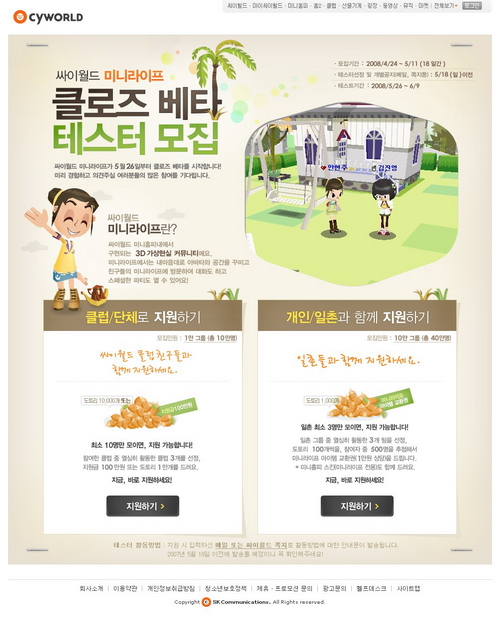
- 2008/04/30 Cyworld 3D about to enter closed beta
- 2008/04/07 Cyworld to launch a blog service
This is from last week, but definitely needs revisiting. Cyworld US announced it's closing its service. Well, services can close (though basically it's a disaster and it shouldn't happen, as people lose their data), but the real problem is how horribly the company is handling the whole situation. I am appalled by the lack of professionalism in the email notice they sent out. How could they not hire a single English-speaking person to write an email of this importance? The email is so full of grammatical errors that almost half of commenters in the Techcrunch article actually think it was poorly translated by Google Translate, while the email was originally written in English.
Thank you to all members with Cyworld.
Due to Cyworld shuts down US service, US Cyworld will no longer be able to service. We sincerely apologize for shutting down the service with unavoidable reason.Before US cyworld close the service, you will continue to access to US cyworld contents but not purchase items. Also, you will not use your acorns.If you have unused acorns, you will be given a full refund for paid acorns only.
Refunds and data backup service is in progress, using the acorn will no longer be able to purchase for miniroom items, skins, etc.
@ Schedule for closing US Cyworld serviceDue to Data Back-up and closing service issues, the service will be unavailable.
* Shop service will be unavailable since Nov 03, 2009Club service, Profile photo/data upload serivce will be unavailable since Nov 23, 2009
But the poor English aside, a more fundamental issue is how they handle the user data. They do not provide any data back-up (in .zip or .xml), nor do they provide a smooth transition path to other Cyworld domains (such as Cyworld Korea). They are so hastily taking off that they are leaving everyone's data behind. This is so wrong. Apparently "graceful retirement" is not in their dictionary. Well, judging from the quality of their email, I wonder if they have a dictionary in the first place.
Before discounting Koreans in general, I would like to say that this is a rather universal case of a big company screwing a small startup it had purchased without understanding the whole industry thoroughly. (Cyworld had been acquired by SK Telecom, and reportedly many senior Telecom folks had moved out to Cyworld to head its business).

Similarly to Facebook, iPhone, and Mixi, Cyworld is also launching (link in Korean) its own version of app store. Earlier, Cyworld had announced plan to support Google's Open Social. Third party application developers will soon be able to write apps that can run on Cyworld Minihompies and submit those apps through "Dev.Square", Cyworld's developer network. Apps will be able to leverage Cyworld's user data and social graph.
Then the apps will be listed on and sold at Cyworld App Store. Consumed applications will be displayed in the user's Minihompy profile or as a post entry.
Users will be able to recommend Cyworld applications to Cyworld friends (1-chons), whether or not they are actually using such apps. Through Open Social activity stream, other users will receive feeds of their friends' newest apps.
Interestingly, Cyworld will only allow free-to-use apps initially. However, that doesn't mean app developers won't be able to monetize off of their apps. Cyworld will allow pay-as-you-go, or "freemium", monetization model (e.g. a game should be freely distributed, but virtual items can be sold within the game). Cyworld will share the incurred revenue 70:30, 70 for app developers. Developers would have much preferred a paid app store, but the "free apps" policy may lead to a wider initial adoption of the apps anyway.
For those who are familiar with Facebook and iPhone app stores, nothing much in the Cyworld app store plan jumps to the eye. It all sounds familiar, which actually makes one wonder why it took this long for Cyworld to build its app store.
Also, like other social networks embracing Open Social, Cyworld is focusing entirely on getting apps onto its container site ("Out=>In", so to speak), while not supporting external apps to import Cyworld social data ("In=>Out"). Later case might lead to many more interesting opportunities (imagine finding your Cyworld buddy's Wishlist right on an online bookstore), but in defense of Cyworld, other social networks are also much more sheepish about exporting their social graph out, as opposed to enriching apps and thereby drawing more users to their own sites. Stay tuned for more updates about Cyworld App store.
Image from Google
At this point, it is not 100% clear how far the company will go in terms of integrating Open Social in Cyworld. Most basic implementation can be something like making Cyworld an Open Social container so that Korea's third party developers can introduce and sell interesting small applications to the minihompy users. That's almost given, I would say, but it will be more cool to see Cyworld's social graph become available to third party developers so we can see some interesting apps that leverage Cyworld's "1-chon" social graph, or better yet, Dotori (acorns) virtual payment system. If app developers can piggyback on Dotori system, it will allow micro payment and help monetizing apps -- which will lead to more active participation of app developers.
Largely, Cyworld Minihompies have been called a closed ecosystem. Now Cyworld wants to become "as open as Facebook", according to the article quoted above. Hope Open Social will rejuvenate the recently stagnating Cyworld, the "mother of all social networks", by bringing in lots of interesting apps to the game.
CNBC reported Korea's #1 mobile carrier SK Telecom is in talks to acquire Sprint of the US. This is definitely not the first time SK Telecom was rumored to be interested in such a deal.
Should SK Telecom buy Sprint? I think so, given these:
1. SK Group has a fairly deep pocket and has a track record of hit acquisitions, so they will probably make this work right. Sprint is bigger than SK Telecom, but if we talk about the whole SK Group instead of SKT as a single company, it's a whole different story. This is relatively little known outside of Korea, but SK Group, Korea's #3 chaebol (after Samsung Group and LG Group), practically built itself through successful acquisitions. SK Telecom itself was an acquisition, and SKT has been quietly gobbling up content companies including Cyworld over the years. Of course there were some bad deals too (did someone just say Helio?), but you win some and you lose some, right? I believe there are more than enough # of smart guys at SK Group who will make sure a deal of this magnitude won't go sideways.
2. For SK Telecom, which is thriving in the Korean market but has been pretty much nonexistent outside the country, gaining an international presence is the name of the game. You can rule the Korean market as much as you want, but you're still limited to about 20-25 million subscribers range (Korean antitrust law demands SKT to keep its market share to about 50%). Sprint will give them a pretty nice presence in the ever-important US market, as well as a decent number of subscribers.
Image from Google
But even if SK Telecom indeed buys Sprint, one thing they should never ever do is to try to inject Korean blood (human resource, corporate culture, services not localized enough, etc) into the American body. That doesn't work, and I'm sure everyone at SKT knows it by now very well, through their largely failed attempt to bring Cyworld to the US.
Cyworld 3D, dubbed Cyworld Mini Life, officially launched. Cyworld Mini Life users (who are represented by 3-D avatars) can chat with others, purchase virtual items, and decorate their Mini Life rooms.
It seems all the existing minihompy users are given a new Mini Life, if they choose to have one. Cyworld Mini Life runs on a minihompy-sized screen, meaning the service doesn't use the full screen real estate as Second Life does.
For the time being, Cyworld Mini Life is Windows/IE only - it asks user to download and install an Active X program, meaning the service does not support Firefox or other non-IE browsers yet.
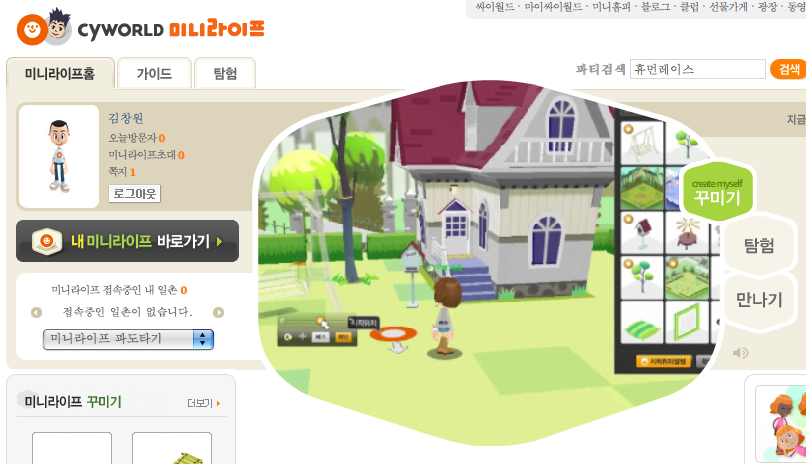
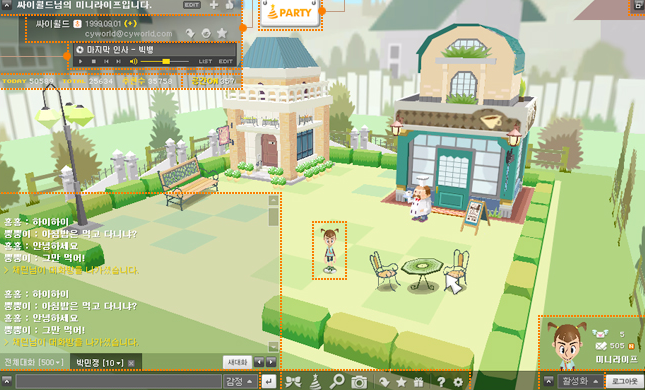
There's an onine video that introduces Cyworld 3D, which looks quite interesting - but I can't embed the video here as it's embeddable only on, guess where, Cyworld minihompy.
But the news of the Cyworld 3D suddenly became a tad less exciting, after a host of new announcements made overnight by Google and IBM. Google announced Lively, which lets site owners to design and embed their own 3-D virtual rooms; IBM and Second Life announced 3-D virtual world interoperability.
It seems all the existing minihompy users are given a new Mini Life, if they choose to have one. Cyworld Mini Life runs on a minihompy-sized screen, meaning the service doesn't use the full screen real estate as Second Life does.
For the time being, Cyworld Mini Life is Windows/IE only - it asks user to download and install an Active X program, meaning the service does not support Firefox or other non-IE browsers yet.
There's an onine video that introduces Cyworld 3D, which looks quite interesting - but I can't embed the video here as it's embeddable only on, guess where, Cyworld minihompy.
But the news of the Cyworld 3D suddenly became a tad less exciting, after a host of new announcements made overnight by Google and IBM. Google announced Lively, which lets site owners to design and embed their own 3-D virtual rooms; IBM and Second Life announced 3-D virtual world interoperability.
Venturebeat's Eric Eldon reports "Friendster’s growth in Asia could make it the top social network in the world, once again." The article quotes Friendster's claim that they are the number one social network service in Asia, leading everyone (Facebook, Myspace, Mixi, Cyworld) by a big margin.
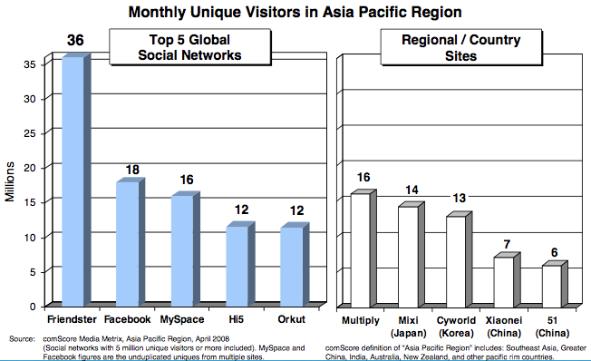
Wait a minue.. Friendster number one in Asia? Every day, I'm getting emails from Facebook and LinkedIn about a new friend request or new updates from my friends. But I haven't had a single email from Friendster for a long time. So at least for me, Friendster doesn't feel like a very active service - But then I may not be profiled as an "average" internet user in Asia.
Stats like these bring a question to my mind: Will the Western/US social network services (Myspace, FB, Friendster) take over the Asian market eventually? Or, will one of the local players (Mixi, Cyworld, 51.com) come out as the Asia's social network winner, transforming itself into a regional market leader that can compete neck-and-neck with Myspace and FB in the global market? Or will every single Asian market have its own social network of choice, without going the consolidation route? What do you think?
Wait a minue.. Friendster number one in Asia? Every day, I'm getting emails from Facebook and LinkedIn about a new friend request or new updates from my friends. But I haven't had a single email from Friendster for a long time. So at least for me, Friendster doesn't feel like a very active service - But then I may not be profiled as an "average" internet user in Asia.
Stats like these bring a question to my mind: Will the Western/US social network services (Myspace, FB, Friendster) take over the Asian market eventually? Or, will one of the local players (Mixi, Cyworld, 51.com) come out as the Asia's social network winner, transforming itself into a regional market leader that can compete neck-and-neck with Myspace and FB in the global market? Or will every single Asian market have its own social network of choice, without going the consolidation route? What do you think?
On June 13, I was at the OpenSocial Conference '08. Here's my coverage:
The 450-capacity auditorium was packed – showing the high interest in open platform technologies. First up was the keynote by Chul-soo Ahn, the president of Ahnlab and a professor at KAIST teaching entrepreneurship. His keynote was about entrepreneurship in Silicon Valley and in Korea - a rather classic topic, but more relevant as Ahn has just come back from the Valley after being there for years. He asserted that Korean entrepreneurs and startup employees should be more focused rather than being "generalists"; also that Korean venture capital should not be a mere "money-loaning bank".
Next, Hyunsoo Hwang, a manager at Cyworld gave a talk about Cyworld and the open internet. Interesting he should say about Cyworld and the open internet as the service is widely regarded as a rather closed service... Anyways, he said Cyworld is trying to implement open data interchange with third parties - For example, if you write a book review on Cyworld's minihompy, the same review might one day also appear on the online bookstore's website.
What I found interesting was Hwang's talk on the social network monetization. Hwang said that the reason why contextual ads work very well on internet search is because the service knows the user's intention. So that means if there's a way social networks can also capture people's intention right (which should be very challenging), then he doesn't see why contextual ads on social networks should not work well too.
It is well known that Cyworld is actually one of only few social network services around the world that generate enough profit, by selling digital items such as background music or avatars. It's interesting that Cyworld seems to be focusing on improving search experience these days - Has Cyworld's digital items revenue hit the wall or something? Is Cyworld interested in generating search-related revenues, such as contextual ads? I don't know..
Traditionally, Cyworld's hottest service has been photo album. But lately, Cyworld diary, a short-form blog of sort, has picked up significant usage. Probably the same reason why Twitter has been popular - people are busier, and they want quick and easy writing over putting up pics.
It turns out that 60% of Cyworld visits occur among 1-chon (i.e. friends) while 40% among non-friends. These statistics from one of the major social networks of the world verifies that social networks are mostly for strengthening the relationships among those who already know each other.
In another session, Kyosuk Song Andy Kyoseok Song at Ahnlab introduced IDtail, the first Korean service (and the fourth in the world) that fully implemented open social. I've heard unofficially quite a few times that this service is one of the best practices (if not the best) of open social technologies.
IDTail is basically a Linkedin-like service an OpenSocial-based social network service. It's an open social container into which various open social apps can be plugged. Song said that after rolling out open social apps, IDtail's unique visitors increased by 250%.
In the following session, Sangsuk Lee of 3Cim Korea shared some "inside stories" related to open social. This interesting Korean startup is based in Silicon Valley and in Korea, and runs a photo widget service called MagToo and MagShow.
After developing application based in open social, they say that opensocial's promise of “Write once, run everywhere” should be taken with a grain of salt – different service providers have different specs, and for their own case, they could launch only on Myspace despite working for over 4 months on Opensocial. But they say Open Social certainly cuts down the development time.
Their application, Magshow, shows well what an OpenSocial application can do; Magshow allows Facebook or other social network users to display all their friends' pictures in one place (such as under profile) without having to visit each one's page.
The 450-capacity auditorium was packed – showing the high interest in open platform technologies. First up was the keynote by Chul-soo Ahn, the president of Ahnlab and a professor at KAIST teaching entrepreneurship. His keynote was about entrepreneurship in Silicon Valley and in Korea - a rather classic topic, but more relevant as Ahn has just come back from the Valley after being there for years. He asserted that Korean entrepreneurs and startup employees should be more focused rather than being "generalists"; also that Korean venture capital should not be a mere "money-loaning bank".
Next, Hyunsoo Hwang, a manager at Cyworld gave a talk about Cyworld and the open internet. Interesting he should say about Cyworld and the open internet as the service is widely regarded as a rather closed service... Anyways, he said Cyworld is trying to implement open data interchange with third parties - For example, if you write a book review on Cyworld's minihompy, the same review might one day also appear on the online bookstore's website.
What I found interesting was Hwang's talk on the social network monetization. Hwang said that the reason why contextual ads work very well on internet search is because the service knows the user's intention. So that means if there's a way social networks can also capture people's intention right (which should be very challenging), then he doesn't see why contextual ads on social networks should not work well too.
It is well known that Cyworld is actually one of only few social network services around the world that generate enough profit, by selling digital items such as background music or avatars. It's interesting that Cyworld seems to be focusing on improving search experience these days - Has Cyworld's digital items revenue hit the wall or something? Is Cyworld interested in generating search-related revenues, such as contextual ads? I don't know..
Traditionally, Cyworld's hottest service has been photo album. But lately, Cyworld diary, a short-form blog of sort, has picked up significant usage. Probably the same reason why Twitter has been popular - people are busier, and they want quick and easy writing over putting up pics.
It turns out that 60% of Cyworld visits occur among 1-chon (i.e. friends) while 40% among non-friends. These statistics from one of the major social networks of the world verifies that social networks are mostly for strengthening the relationships among those who already know each other.
In another session, Kyosuk Song Andy Kyoseok Song at Ahnlab introduced IDtail, the first Korean service (and the fourth in the world) that fully implemented open social. I've heard unofficially quite a few times that this service is one of the best practices (if not the best) of open social technologies.
IDTail is basically a Linkedin-like service an OpenSocial-based social network service. It's an open social container into which various open social apps can be plugged. Song said that after rolling out open social apps, IDtail's unique visitors increased by 250%.
In the following session, Sangsuk Lee of 3Cim Korea shared some "inside stories" related to open social. This interesting Korean startup is based in Silicon Valley and in Korea, and runs a photo widget service called MagToo and MagShow.
After developing application based in open social, they say that opensocial's promise of “Write once, run everywhere” should be taken with a grain of salt – different service providers have different specs, and for their own case, they could launch only on Myspace despite working for over 4 months on Opensocial. But they say Open Social certainly cuts down the development time.
Their application, Magshow, shows well what an OpenSocial application can do; Magshow allows Facebook or other social network users to display all their friends' pictures in one place (such as under profile) without having to visit each one's page.
Cyworld Japan announced a site renewal plan where it will essentially turn into a place for pro-Korean community in Japan.
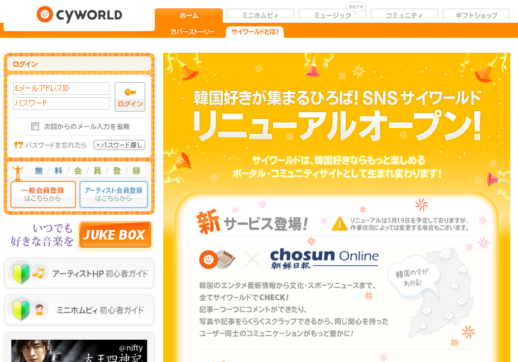
This might make sense as what little number of Cyworld users in Japan are mostly K-wave followers or Korean expats anyway.
But on the other hand, this is something like, let's say, Xing France announcing it will focus on offering German job information to French people. Bad analogy, I know, but my point is Cyworld JP is essentially turning itself into a service that's quite limited to serving small, niche demographics. Which is their own statement that Cyworld JP is irrelevent to the mainstream Japanese web users.
Just another evidence that in Asian web industry, it seems so difficult (nearly impossible) to produce a "cross-cultural" hit service, whose success isn't limited only to its own country. Which is a topic that's well worth discussing in our upcoming Asia Web conference.
This might make sense as what little number of Cyworld users in Japan are mostly K-wave followers or Korean expats anyway.
But on the other hand, this is something like, let's say, Xing France announcing it will focus on offering German job information to French people. Bad analogy, I know, but my point is Cyworld JP is essentially turning itself into a service that's quite limited to serving small, niche demographics. Which is their own statement that Cyworld JP is irrelevent to the mainstream Japanese web users.
Just another evidence that in Asian web industry, it seems so difficult (nearly impossible) to produce a "cross-cultural" hit service, whose success isn't limited only to its own country. Which is a topic that's well worth discussing in our upcoming Asia Web conference.
Cyworld "Minilife", aka Cyworld 3D, is about to start closed beta service. They are accepting up to 500,000 closed beta users (about 2% of their current user base of 22 million). Cyworld Minilife is a Second Life-like virtual 3D social network service, and is expected to launch in June this year. So far I'm not that impressed, but will deliver updates anyway.
Cyworld is launching a blog service (link in Korean) - well, technically, they're not launching a new service, but changing the name of their existing Home2 service. With their "Cyworld Blog" initiative, Cyworld might add more features down the road, but at least for the time being, the change seems pretty cosmetic.
 What is Home 2? As the suffix "2" tells, Cyworld has made a longtime effort to bring forth an upgraded version of their popular yet aging (i.e. slow growth) minihompy service. As popular as minihompy service was, Cyworld knew that nothing can be popular forever and they had to come up with the new engine of growth.
So they put together a team of brilliant strategists (including Marc Canter of the US, it's widely known) and spent numerous hours on brainstorming sessions. The service that came out of that effort was Cyworld Home 2 (out in spring 2007) - which was essentially a blog service with some robust frontpage editing features (widgets, page addition, etc) and 1-chon (Cyworld's friend system).

However, Home 2 service never really clicked with the Cyworld minihompy users. Minihompy users didn't perceive the more blog-like Home 2 service as the natural next step to their minihompies and therefore didn't rush to Home 2. The fact that Home 2 was packed with all the bells and whistles also meant the service didn't have a very clear focus. When introduced to Home 2, minihompy users were like, "ok, so why am I supposed to use this?"
So Home 2 was by and large a flop, but to make matters worse, the situation isn't all that rosy for the minihompy service either - it's under a double threat of a) decreasing traffic in its domestic Korean market and b) struggle in virtually all foreign markets it entered into.
Which is why the re-naming of Home 2 to Cyworld Blog seems to have come from desperation rather than from a well-devised strategy.
Cyworld is perhaps undergoing a textbook case of innovator's dilemma: Once great, now slowly aging. Massive self-reinvention effort in the name of Home 2 didn't exactly succeed. Again, if you were Cyworld CEO, what would you do? Certainly a nice brain-teaser.
So they put together a team of brilliant strategists (including Marc Canter of the US, it's widely known) and spent numerous hours on brainstorming sessions. The service that came out of that effort was Cyworld Home 2 (out in spring 2007) - which was essentially a blog service with some robust frontpage editing features (widgets, page addition, etc) and 1-chon (Cyworld's friend system).
However, Home 2 service never really clicked with the Cyworld minihompy users. Minihompy users didn't perceive the more blog-like Home 2 service as the natural next step to their minihompies and therefore didn't rush to Home 2. The fact that Home 2 was packed with all the bells and whistles also meant the service didn't have a very clear focus. When introduced to Home 2, minihompy users were like, "ok, so why am I supposed to use this?"
So Home 2 was by and large a flop, but to make matters worse, the situation isn't all that rosy for the minihompy service either - it's under a double threat of a) decreasing traffic in its domestic Korean market and b) struggle in virtually all foreign markets it entered into.
Which is why the re-naming of Home 2 to Cyworld Blog seems to have come from desperation rather than from a well-devised strategy.
Cyworld is perhaps undergoing a textbook case of innovator's dilemma: Once great, now slowly aging. Massive self-reinvention effort in the name of Home 2 didn't exactly succeed. Again, if you were Cyworld CEO, what would you do? Certainly a nice brain-teaser.