20 Articles for 'Mobile'
- 2009/11/11 Samsung Bada is Yet Another Mobile Platform (3)
- 2009/08/11 Naver Japan Mobile Beta (1)
- 2009/02/28 Universal Chargers: nothing new for Korea (7)
- 2009/02/09 Samsung Mobile to Join the App Store Fray: Are Apps Stores Dime a Dozen?
- 2008/08/26 Mugeta: a blatant Mobage knock-off (1)
- 2008/07/29 3G means profit hemorrhage
- 2008/06/26 Tossi gives you a mission to accomplish with your mobile phone
- 2008/04/15 Japan's NTT DoCoMo sees its market share drop below 50%
- 2008/04/07 Who are the hottest mobile startups in China?
- 2008/02/20 Most Popular Mobile Websites of Korea Announced
Samsung announced its new mobile platform called Bada. Bada means "Ocean" in Korean; the word can also mean "to download" (an app), so I guess branding-wise, Bada couldn't have been more aptly named, at least for Korean-speaking audience.
So what is Bada? The "About" section of Bada homepage gives an intro, which I think is unnecessarily long and yet somehow fails to get to the point. In a nutshell, Bada is Samsung's Symbian. Bada entails a new, Samsung-developed smartphone operating system, Samsung's app store, and Samsung app developer program.
So Bada joins Symbian, iPhone, Android, Windows Mobile, and Blackberry as yet another "mobile apps platform". One has to wonder why the world needs yet another "platform" when it has iPhone and Android, but after all this might not be insignificant, given Samsung's footprint in the global mobile handset market. Samsung's Q3 2009 worldwide market share was 21.0%, putting itself in a solid #2 spot and getting more and more neck-and-neck with Nokia (37.8%). Of course these are total sales and we would see a significantly different landscape if we focus only on smartphones, which Bada seems to focus on. But one can imagine the proportion of smartphones in Samsung's phone lineup will only grow, hence the higher importance of Bada. For developers though, Bada may translate into yet another platform to customize their apps to.

It was recently announced in Barcelona that all the major cell phone manufacturers will start to use a single universal charger by the year 2012. This announcement at the 2009 Mobile World Congress will also include Korean giants LG and Samsung. Soon, a universal Micro-USB technology will be used across the board.
So, what’s the big deal?
Korea has had a universal charger for a few years now. Any cell phone can use the same charger. Imagine you’re over at a friend’s house and your phone’s battery is running low? No problem, use their charger to bring your battery back to life. How convenient is it to be able to run into a convenience mart and drop off your phone to be recharged, come back and it’s ready to go. Now the rest of the world is catching on and deciding that is a good idea.
Of course there are some good and bad that will stem from this initiative. Luckily, I feel that the good far outweighs the bad. First of all each cell phone operator, at least in the US, has developed its own proprietary connection for its cell phone. So we have many different styles of connectors. It’s bad for the companies because they will be losing sales by selling their own chargers and connecting wires. It’s good for the consumer because now we can easily purchase a cheaper costing charger from any electronics store or even borrow that extra charger that our friend has, permanently.
Other than that, I only see good possibilities moving forward with this initiative. I think we will all start seeing the wasted production of all these different chargers going out the door. This may create extra production capacity which can be used for something else creating a more efficient world. Also, it will become less of a strain for the environment having to deal with all the extra chargers that are unused throughout the world and just thrown away. Companies could even start leaving chargers out of their original packaging. If they decide to build chargers out of their pricing models they could possibly increase their revenues through selling chargers upon customer request.
So what does this have to do with Korea? It shows that once again an initiative that Korea decided was good for the country has been validated. Korea continues to remain at the forefront of cell phone technology and thinking. Perhaps wireless power adapters will be the next addition to Korean handheld devices. Maybe that’s a little too forward but since we won’t be seeing the new Micro-USB chargers coming out in full force until 2012 we can already count one point for Korea being a couple years ahead of the initiative.
++
Samsung Mobile to Join the App Store Fray: Are Apps Stores Dime a Dozen?
Mobile | 2009/02/09 23:29 | Web 2.0 Asia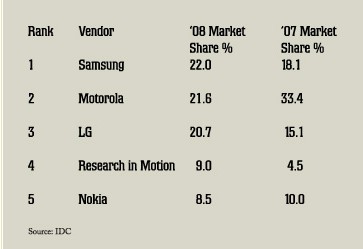
2008 US mobile phone market share among manufacturers (source IDC)
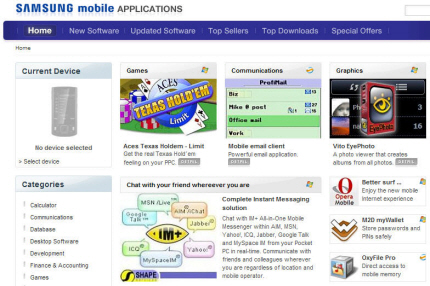
This came on my radar only recently, but there is a Korean mobile game and social network service called "Mugeta", that has copied Japan's popular Mobage service (short for "Mobagetown", or "Mobile Game Town") down to the name itself: "Mugeta" in Korean is short for "Muryo (free) Game Town".
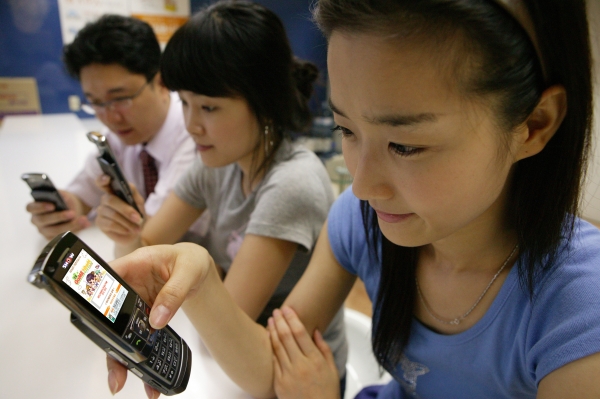
Photo from ETNews.co.kr
The service is provided by Entaz, a mobile content service provider, through KTF (Korea's #2 carrier). Mugeta began service in April this year, and reached 0.2 million subscribers mark in just four months. To put this in perspective, Mobagetown of Japan has been around since February 2006 and today has 9 million subscribers. So at least in terms of growth, Mugeta is pretty impressive.
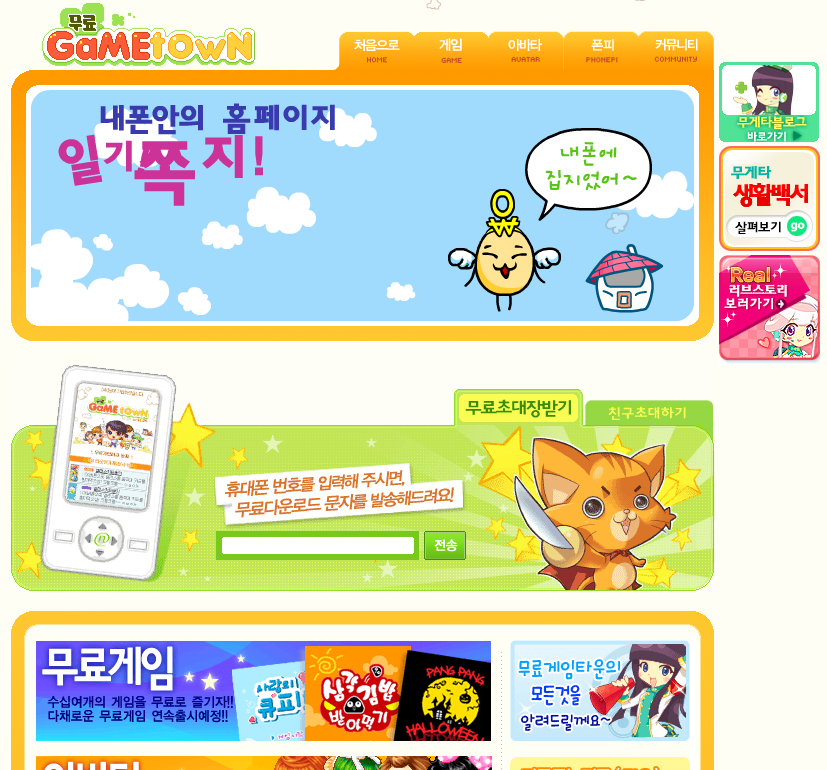
Mugeta is free - users get mobile games (there are 58 game titles available now), avatars, mobile homepage (called "phone-py", perhaps after the minihompy), all for free. Mobagetown also used its free content to build up the initial user-base, and when they amassed a big user base, monetization followed.
KTF says over 70% of Mugeta service users are teens (under 20), and female users take up 43%, which is pretty high compared to other mobile content services.
Well, in this age of globalization, a best practices in one country can get copied very quickly in other countries. People may quickly point their fingers to China, as that's an easy one to spot, but StudiVZ shows that Germans know how to copy, too. That said, I seriously wonder if Mugeta has partnered up with DeNA (the provider of Mobagetown) or is paying them royalty. Otherwise, I would be very uncomfortable.
If you are in the US, often the TV ads you most frequently see are those for new cars. Well if you are in Korea, you are almost drowned by the mobile carriers' 3G TV ads. Some are humorous, some dead serious, but all those ads try to send out the single message: Become a member of our 3G service. Like this TV commercial on KTF's 3G service, which is about giving old folks shiny new 3G phones as a gift. (Now they are targeting the old folks? Come on, apparently they are trying to squeeze the last drop out of the market...)
Worse, "marketing budget" for mobile carriers doesn't only mean TV commercial costs. In fact, TV commercials only take up a minor share of their marketing budget. There's subsidies, MNP (mobile number portability) benefits, commissions to be paid out to shops, etc.
As a result, Korean mobile carriers saw profit slide in Q2: SKT spent roughly US$ 880mm in Q2, while KTF spent around US$ 620mm. To put these numbers in perspective, KTF's marketing expenditure was 40% of their whole revenue (not of profit). Both companies saw their stock price go down after the profit announcements.
But as all major carriers spent big money on marketing, the market share among the three carriers turned out to have stayed largely the same. So why bother with marketing? one might ask. Of course if you are from advertising industry, you'd not ask that question, but would hope the carriers will forever stay on their marketing binge.
Tossi gives you a mission to accomplish with your mobile phone
Mobile | 2008/06/26 19:23 | Web 2.0 AsiaTossi is running an interesting promotion to drive usage from mobile devices. The service gives you a daily mission to accomplish, which requires taking a photo with camera phone and uploading the photo to Tossi via MMS.
On the following screen shot is a new mission, "Show us the sky above you now". The winners get mobile coupon for a free Starbucks latte.
It's an interesting marketing initiative, but it can also be an evidence that still not many people are aware of, or using, the Twitter-like service from their mobile phones.
The winner in this fully saturated Japanese mobile service market (read: a zero-sum game) seems to be Softbank Mobile. (My previous piece about DoCoMo vs. Softbank Mobile is here).
Meanwhile, NTT DoCoMo will test mobile fragrance service: Like ringtones, "scents" can be downloaded and played back (ie. generated) by a phone-embedded aroma generator. Well, mobile fragrance service is surely cool and futuristic and all that, but I guess they should first do something about their "stinking" market performance.
Tokiva is a mobile virtual network operator which provide convenient and low-cost communication service to global traveler. Tokiva addresses key communications necessities for global travelers: inexpensively phone calls around the world, accessing email and sharing with peers.You can check out the rest of the winners here.After installing its mobile client and log in, you can call any number. Tokiva calls the user back and immediately connects the user to the called party. It also integrated with IM, so you can add its IM bot to use the service without downloading its client.
The service was privately launched in September 2007, and entered public beta with over 700k registered users on January 2008.
Mobile Monday Beijing is being spearheaded by our friend Benjamin Joffe, whose consulting work has recently been introduced on Read/Write Web.
As background info, WINC is the new and easier way of accessing mobile websites, proposed by NIDA and implemented on over 90% of mobile phones sold in Korea. Instead of typing the long and complex mobile URLs on cellphone keypads, users can just type a simple phone number and press the mobile internet key (you know - those buttons with "i" or "n" on them) to get connected to mobile websites. For instance, type "131", press the n key, and you are on the weather forecasting mobile website.
Obviously, not everyone who uses mobile internet accesses via WINC, so the "most popular WINC sites" list may not exactly represent the most popular mobile sites. Anyhow, the popular WINC sites for 2007 came out to be:
- Bus schedule service, City of Daegu
- Bus schedule service, City of Seoul
- Naver Mobile (portal)
- Daum Mobile (portal)
- Hanguk Economy News TV
- Chosul Ilbo (newspaper)
- Gamevil (mobile game)
- Com2Us (mobile game)
- Samsung Securities (stock trading site)